London/ New Delhi: The decision by the United Kingdom to cancel the Mid-Life Upgrade (MLU) for the Meteor beyond-visual-range air-to-air missile marks a definitive shift in European defence strategy, with significant ripple effects for India. Over the next decade, India is projected to host the largest fleet of Rafale combat jets outside of France, making its reliance on the Meteor a central pillar of its long-term aerial superiority strategy.
According to the UK Ministry of Defence, resources originally allocated for modernising the Meteor are being redirected into the Future Air Superiority Effectors (FASE) programme. Currently in its pre-concept phase, FASE is a collaborative initiative aimed at developing a next-generation air-to-air weapon system to eventually replace the Meteor altogether. This transition took a formal step forward when the UK and France signed a Memorandum of Understanding to launch a 12-month joint study focused on defining this successor capability.

This policy pivot highlights a broader shift in Western military planning. Instead of financing incremental hardware updates for current platforms, planners in London and Paris are focusing resources on an entirely new tier of long-range aerial weapons. This upcoming generation of missiles is being designed from the ground up to counter sophisticated emerging threats, including sixth-generation stealth fighters, expansive drone swarms, heavily contested electronic warfare environments, and hypersonic vectors.
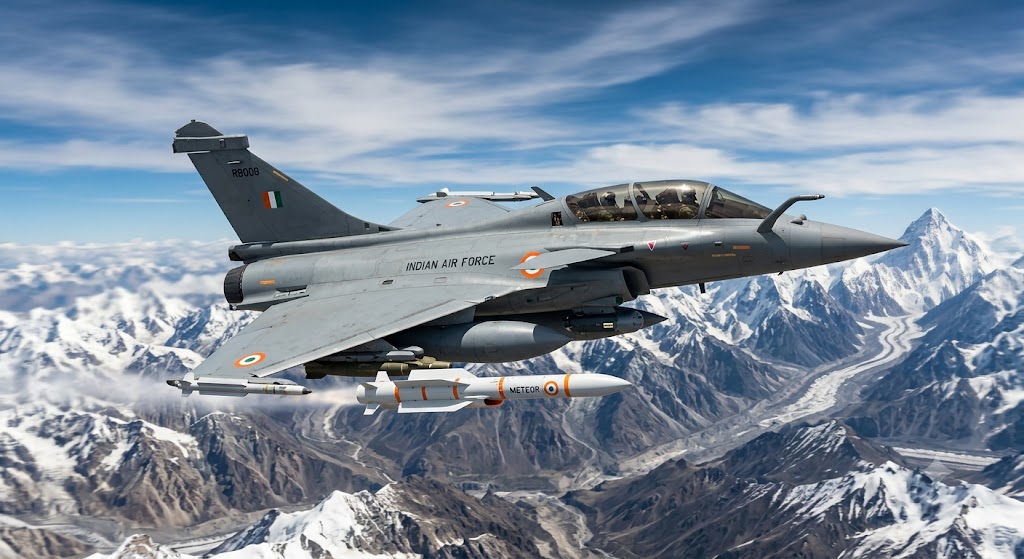
For the Indian military, this strategic realignment introduces a complex set of operational variables. The Indian Air Force currently relies on the Meteor as the primary beyond-visual-range weapon for its Rafale fleet, where it is regarded as a benchmark system. Featuring an advanced throttleable ramjet engine, the Meteor maintains high speed and energy across its entire flight profile, delivering a significantly larger “no-escape zone” than conventional solid-rocket alternatives.
With the Indian Air Force planning to operate the Meteor into the 2040s, and the Indian Navy acquiring the Rafale Marine variant, India’s total inventory of Rafale fighters is expected to surpass 100 units. This substantial commitment positions New Delhi as one of the primary stakeholders in the missile’s operational ecosystem.
The cancellation of the MLU does not mean current Meteor inventories are obsolete. The manufacturer will continue to provide routine maintenance, software enhancements, and production integration support for existing global operators. The missile’s current performance envelope remains highly effective and will continue to serve as a reliable deterrent for years to come.
However, the absence of the MLU means the Indian Air Force will not benefit from major hardware evolutions under the legacy Meteor program. Anticipated upgrades—such as an advanced radar seeker, heightened electronic counter-countermeasures, propulsion modifications, or a major extension in maximum range—are effectively off the table for this specific airframe.
As regional dynamics evolve, this freeze on Meteor hardware modifications could generate strategic vulnerabilities over time. China continues to introduce highly capable long-range air-to-air systems, such as the PL-15 with its dual-pulse rocket motor, alongside ultra-long-range platforms like the PL-17, which is designed to engage high-value aerial assets at extreme ranges. Furthermore, next-generation Chinese stealth fighters emphasize dense sensor fusion and advanced electronic warfare suites specifically tailored to disrupt incoming missile guidance systems. Simultaneously, Pakistan is actively modernising its aerial capabilities by integrating these advanced Chinese weapon systems, altering the tactical balance along India’s western border.

To counter the baseline stagnation of the Meteor platform, New Delhi will likely need to evaluate alternative long-term pathways to maintain its edge in beyond-visual-range combat.
One option is to seek entry into the European successor program when export variations emerge. Given India’s deep institutional defence ties with France, New Delhi could leverage its position to negotiate early access or collaborative alignment with the technologies coming out of the UK-France FASE initiative, especially since the Rafale will remain a cornerstone of Indian air power past 2045.
Alternatively, India can turn inward, relying on domestic development programs to address future operational shortfalls. The Defence Research and Development Organisation (DRDO) has made steady progress with the indigenous Astra missile family. The upcoming Astra Mk2 is designed to provide a significant range extension over the current Mk1 baseline. More critically, the Astra Mk3 is being engineered around Solid Fuel Ducted Ramjet (SFDR) technology—a propulsion mechanism similar to the Meteor—specifically to compete with top-tier international long-range systems. Future blocks of the Astra lineage could serve as domestic vectors to integrate the advanced seeker and propulsion technologies originally envisioned for the Meteor upgrade.
India’s massive industrial footprint in the Rafale platform provides an important point of leverage. Operating an aggregated fleet of over 60 Rafales across branches, with numbers set to expand, India represents a vital market for European aerospace consortiums. This operational volume offers New Delhi the institutional weight required to ensure future next-generation European munitions can be integrated onto Indian airframes, or to advocate for co-development roles if France opens the FASE framework to strategic partners.
Ultimately, the halt of the Meteor upgrade serves as a clear reminder of a fundamental tenet in defence procurement: relying entirely on foreign weapon systems binds a nation’s modernization timelines to the strategic priorities of the manufacturer’s home country rather than the buyer’s immediate operational reality. When a developer alters course, user nations must adapt using existing stock or forge an independent solution.
While the Meteor will remain an exceptionally capable tool for the Indian Air Force through the 2030s, its altered technology roadmap emphasizes the strategic necessity for India to accelerate its domestic long-range missile initiatives while systematically managing its European defence partnerships for the next generation of air combat.